
SEO audits help businesses understand why a website may not be getting the traffic, rankings or conversions businesses expect. I have seen sites that look fine but still miss traffic.. Not every audit must be done in exactly the same way.
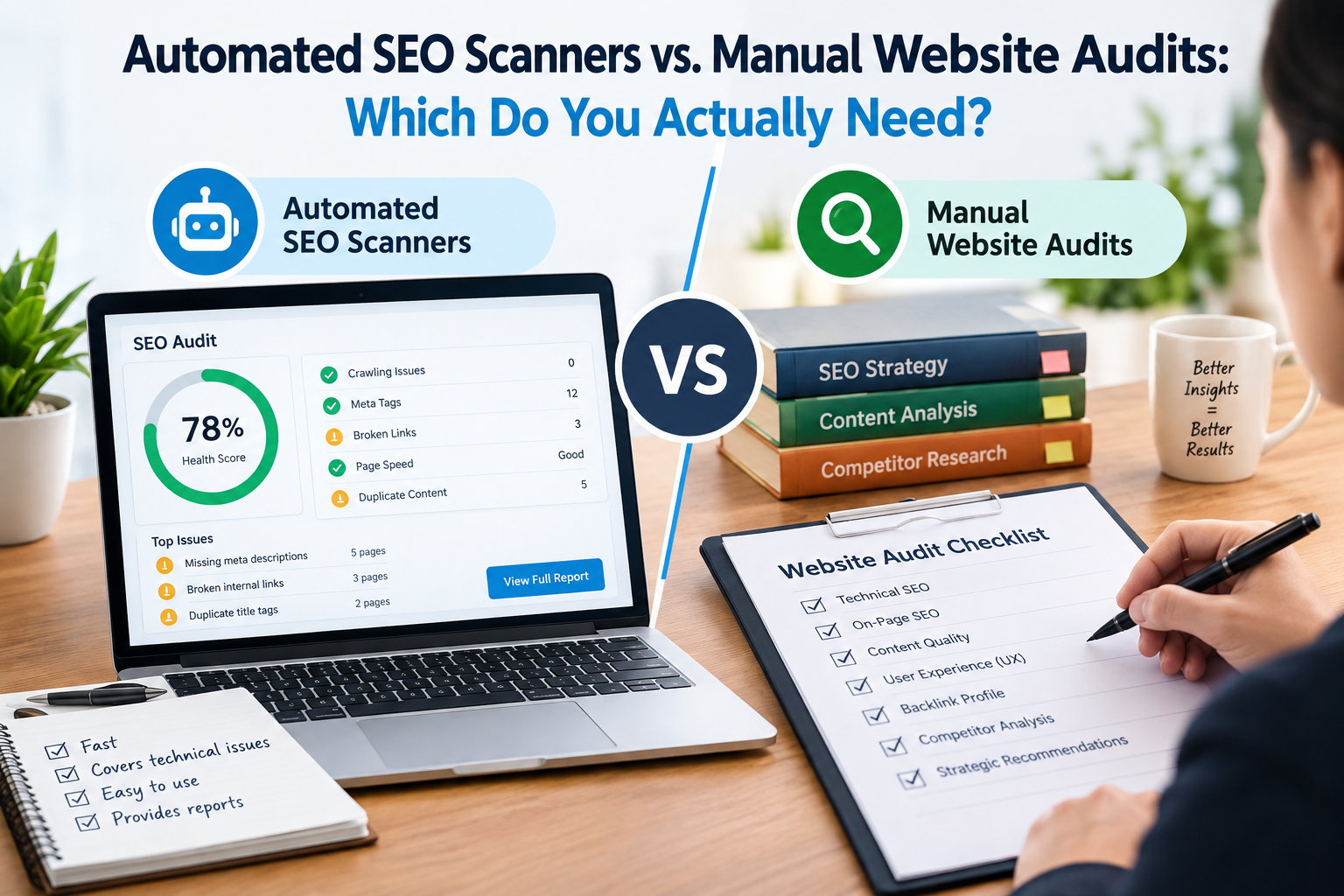
Automated SEO scanners can quickly find problems on hundreds or thousands of pages. In practice automation catches the obvious. A person is needed for nuance. Manual website audits on the hand involve human analysis to understand context, priorities and business impact.
The key question is not just which method is better. It is when you need automation when you need analysis and when using both makes the most sense. Choosing the mix depends on your site’s size and goals.
What Is an Automated SEO Scanner?
An automated SEO scanner is a software tool that crawls a website and checks predefined on-page factors. I use one of these tools every month.
Depending on the platform it may identify:
- Broken links
- Missing title tags
- Duplicate descriptions
- Missing H1 tags
- Redirect errors
- Indexing issues
- Canonical problems
- pages
- Large image files
- Sitemap issues
- Mobile-related problems
For large websites automation can save a lot of time because software can process many URLs much faster than a person. That speed is an advantage for big e‑commerce sites.
Benefits of Automated SEO Scanners
Speed: A scanner can crawl a website relatively quickly. I have noticed that consistency helps when tracking changes over time.
Consistency: The same technical checks can be applied across pages.
Scalability: Automation is particularly useful for e-commerce websites and large content libraries.
Issue discovery: Scanners can uncover errors that might otherwise be difficult to find manually.
Monitoring: Some tools allow websites to be checked regularly so new problems can be identified.
What Is a Manual Website Audit?
A manual website audit goes beyond generated warnings. It digs deeper into the user’s experience.
An SEO professional examines the website from a perspective considering its business goals, audience, competitors, content quality, website structure and user journey. That holistic view often reveals opportunities.
For example an automated tool might report that a page has a title. A manual review asks an important question: Does the title clearly communicate the page’s purpose and match what the target audience is searching for? I have seen sites where a long title solves a ranking issue. That difference is important. It can change the outcome.
Automation identifies patterns. Human analysis provides context. Both are needed for a picture.
What Automated Tools Miss
Automated scanners are useful but they cannot understand every aspect of a website. They are good at spotting errors, not intent.
Search Intent
A tool may confirm that a keyword appears on a page. It cannot reliably determine whether the content actually satisfies the user’s underlying search intent. I often test for intent myself. A page targeting ” accounting software” may contain the keyword several times while failing to provide meaningful comparisons pricing information or decision‑making guidance. That can leave visitors confused.
Content Quality
Software can identify duplicate content based on measurable signals but content quality requires deeper evaluation. Real quality shows in relevance and depth. A human reviewer can consider:
- Accuracy
- Originality
- Relevance
- Clarity
- Expertise
- Usefulness
- Content depth
- User Experience
A scanner can detect performance and mobile problems but a human can actually evaluate whether navigation feels confusing or whether the website makes it difficult for visitors to find important information. I often walk through a site to test that.
Conversion Problems
A technical scanner may confirm that a contact form exists. It cannot fully determine whether visitors understand what action they should take or why they should trust the business. I look for calls to action.
Manual Audits Provide Business Context
Not every SEO issue deserves the priority. Prioritization saves time. For example a scanner might identify dozens of missing image alt attributes. Meanwhile the website may have an indexing problem affecting hundreds of important pages. Missing alt text is less urgent than a crawling block. Simply looking at the number of errors can lead to prioritization. That is why a manual review is essential.
A manual audit considers the business impact. I weigh the impact on revenue. A useful prioritization framework is:
So Which One Do You Actually Need?
For websites the answer is both. Combining both gives the results.
I see that automated SEO scanners are excellent for finding issues efficiently. Manual audits are valuable for interpreting those findings and deciding what should actually be fixed first.
I think of an automated scanner as a system that produces a list of potential problems.
A manual audit is the process of understanding those problems in context.
Small Business Websites
I believe a small website may not need automated crawling. Periodic automated scans combined with a review can be sufficient.
E-Commerce Websites
I notice e-commerce sites often have thousands of URLs, product variations, filters and categories. Automation can help identify issues at scale while manual analysis can evaluate category architecture, product pages linking and conversion paths.
Large Content Websites
I see that publishers and large content sites can benefit from automated monitoring because technical problems can appear as new pages are published or old URLs change.
Manual reviews can then focus on quality, information architecture, search intent and important landing pages.
A Better Approach: Combine Both
A practical SEO audit process can look like this:
Step 1: Run an Automated Crawl
I start with an automated scanner to identify on-page issues.
Step 2: Remove False Positives
Not every warning represents a problem. I review the findings before making changes.
Step 3: Identify High-Impact Issues
I prioritize problems affecting pages organic visibility, user experience or conversions.
Step 4: Perform Manual Analysis
I review search intent, content quality, navigation, internal linking, important landing pages and conversion journeys.
Step 5: Create an Action Plan
I turn the findings into recommendations with priorities and owners.
Step 6: Monitor Changes
After implementing fixes I run another crawl. Manually verify important improvements.
Common Mistake: Treating an Audit Score as the Goal
Many SEO tools provide an overall website health score.
That number can be useful for monitoring changes. It should not become the objective itself.
A website does not automatically become successful because an SEO tool reports a score.
The real goals are more meaningful:
crawlability
Stronger search visibility
Improved user experience
Better content relevance
qualified organic traffic
Stronger conversion performance
Final Thoughts
Automated SEO scanners and manual website audits serve different purposes.
Automation is excellent at finding problems quickly and at scale. Manual auditing is better suited, to understanding context evaluating quality and creating priorities.
For a website audit combining both approaches usually creates a more complete picture.
Use automation to discover the issues. Use analysis to understand them. Then prioritize the fixes according to what matters to the website and its users.


