
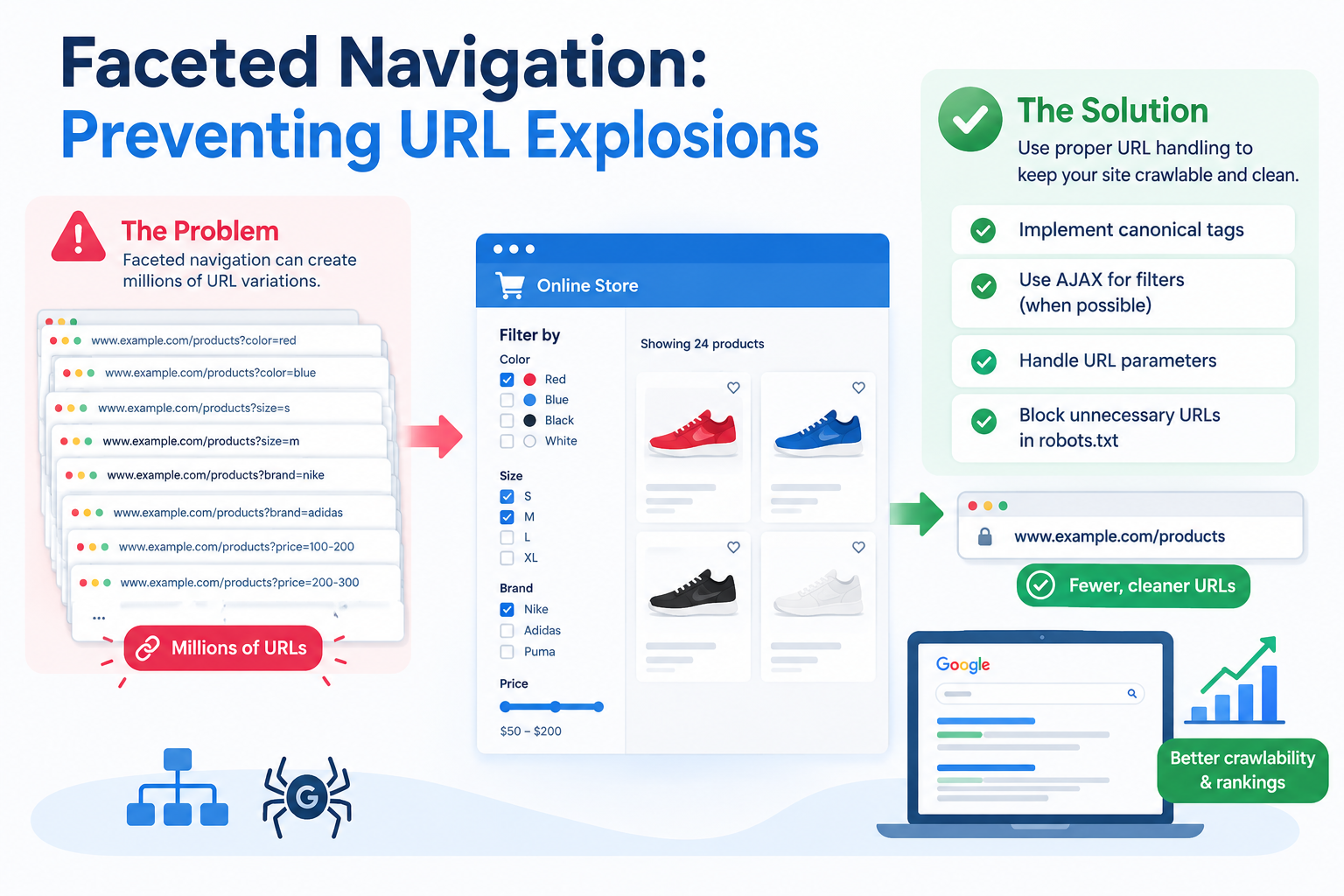
Faceted navigation makes e-commerce websites easier to use. Shoppers can filter products by color, size, price, brand, rating and other attributes.
I notice that the SEO problem starts when faceted navigation creates a crawlable URL for each filter combination.
I see that a store with thousands of products can quickly generate millions of parameter URLs. If these URLs are accessible to search engines and lack controls they can create serious crawl and indexing problems.
What Is Faceted Navigation?
I think faceted navigation is the filtering system commonly found on stores.
For example:
/shop/shoes

/shop/shoes?color=black

/shop/shoes?color=black&size=10

/shop/shoes?color=black&size=10&price=100-200
I think each combination can potentially create another URL.
I find that while these URLs may be useful for shoppers many combinations provide no unique search value.
How URL Explosions Happen
I find a store with filters for:
- 10 colors
- 12 sizes
- 8 brands
- 5 price ranges
- 4 ratings
I see that when users combine these filters the number of possible URLs can grow rapidly.
Sorting options can make the problem even larger:
?sort=price-low

?sort=price-high

?sort=popular

?sort=
I think search engines may discover these URLs through internal links, filter controls, sitemaps or external links.
I notice that without controls the crawler can spend resources processing URLs that have little SEO value.
Why Faceted Navigation Becomes an SEO Problem
1. Crawl Waste
I think search engines may spend crawling resources on thousands of parameter combinations of prioritizing important product and category pages.
2. Duplicate or Near-Duplicate Content
I find that different parameter URLs can display identical product listings.
This creates URLs with little unique content.
3. Index Bloat
I see that if unnecessary parameter pages become indexed the search index can contain numbers of low-value URLs.
4. Weaker Internal Signals
I think when a website has numbers of URLs important pages can become harder for search engines to discover and understand efficiently.
Use Canonicalization Carefully
I find tags can help indicate the preferred version of similar URLs.
For example:
<link href="https://example.com/shoes">
However canonicalization should be implemented consistently and should reflect the sites intended URL structure.
Not every filtered page should automatically point to the category page. Some filter combinations may represent search pages and deserve their own indexable URLs.
Control Unnecessary Parameters
I notice that parameters used for sorting, tracking or temporary interface changes generally should not create large numbers of indexable pages.
For example:
?sort=price-low

?sort=price-high

?utm_source=email
These URLs should be handled according to their purpose than allowed to create unnecessary indexable variations.
AJAX Can Reduce URL Creation
I think e-commerce websites can use AJAX or similar client-side techniques to update product listings without generating a crawlable URL for every interaction.
However important SEO landing pages should still have accessible URLs when there is genuine search demand.
The goal is not to hide content. It is to prevent combinations from becoming unnecessary crawl targets.
Build an SEO-Friendly Faceted Navigation Strategy
I see a practical approach is to divide filters into three groups.
Indexable Filters
I think create URLs for combinations that have genuine search demand and unique value.
Non-Indexable Filters
I find some useful user-interface combinations may not need to appear in search results.
-SEO Parameters
I think sorting, tracking, session and temporary parameters generally should not create valuable search pages.
This classification should be based on the websites content and search strategy.
How to Find Faceted Navigation Problems
I find a technical SEO crawl can reveal:
- Large numbers of parameter URLs
- Duplicate URLs
- Multiple URL variations, for the page
- Missing tags
- Incorrect canonical targets
- Indexable filter combinations
- URL depth
I think Google Search Console can also help identify unusual URL patterns and indexing issues.
Practical Example
Suppose an online clothing store has a category URL:
example.com/shirts
A shopper selects medium, cotton under $50 and sorts by price.

The website creates:

```text

/shirts?color=black&size=medium&material=cotton&price=under50&sort=
If every possible combination can be crawled and indexed millions of similar URLs could be created.
A better plan is to find which combinations should have their SEO pages and to control the others.
How a Website Audit Helps
A Website Audit Service can spot navigation problems by looking at URL patterns, crawl paths, canonical tags how pages can be indexed and internal links.
For e-commerce sites this audit can uncover URL explosions that are hard to find by hand.
Faceted navigation helps shoppers. Filters that are not controlled can create huge numbers of parameter URLs.
The fix is not to take filtering. Instead set rules for which filter combinations should be indexed which should be controlled and which should stay only functional.
Canonical tags, parameter handling, AJAX filtering, internal link limits and regular technical audits can keep e-commerce URL structures under control.
FAQs
What is faceted navigation, in SEO?
Faceted navigation lets users filter products. Each filter combination can make a separate URL.
Why are parameter URLs a problem?
Many unnecessary parameter URLs can create content, too many indexed pages and slow crawling.
Should every filter URL be indexed?
No. Only combinations that give search value and useful unique content usually need to be indexed.
Can canonical tags solve faceted navigation problems?
Canonical tags can help bring URLs together but they must be part of a wider URL and crawl plan.
How can I find navigation bloat?
Use a crawler, Google Search Console, server logs if you have them and URL pattern checks to spot too many parameter combinations.


