
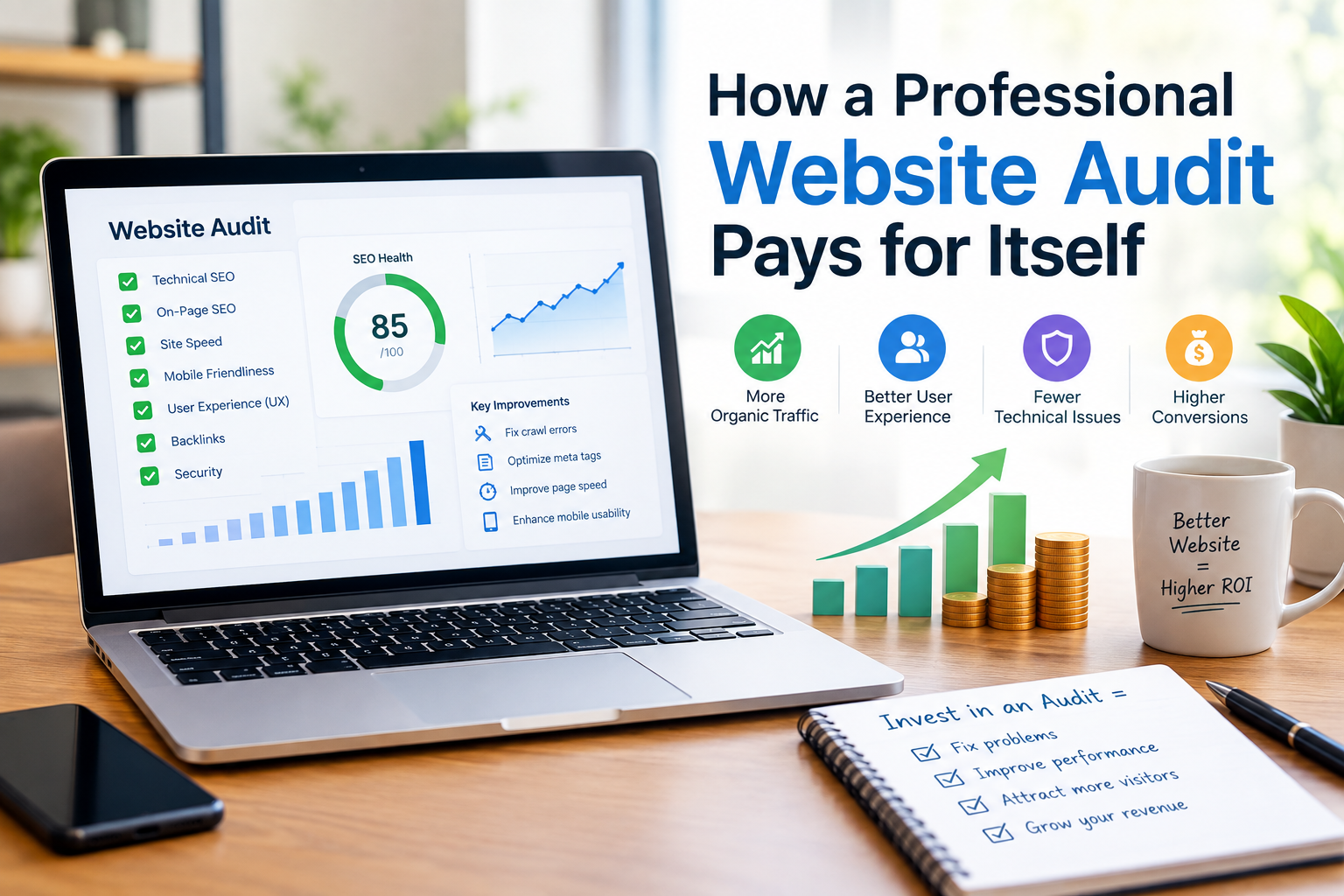
A website is one of the important assets for many businesses. It can attract visitors generate leads, sell products, answer customer questions and support your marketing campaigns.
What happens when your website is quietly losing potential customers?
Slow pages, links, poor navigation, technical SEO errors, confusing content and weak conversion paths can all reduce the value of your website. The problem is that many of these issues are difficult to notice without a review.
This is where a professional website audit can help.
A website audit is not simply a list of errors. When done properly it identifies problems that may be affecting traffic, user experience, conversions and overall website performance. Fixing the problems can create measurable business value and potentially recover opportunities that were being lost.
What Is a Professional Website Audit?
A professional website audit is an examination of your websites technical health, SEO, content, usability, performance and conversion experience.
Depending on the business and website an audit may review:
- SEO
- Crawlability
- Indexability
- Website speed
- usability
- Internal linking
- Content quality
- Metadata
- Website architecture
- links
- Redirects
- User experience
- Conversion paths
- Analytics and tracking
- Security and technical issues
The purpose is to understand what is preventing the website from performing effectively as it could.
How Can a Website Audit Pay for Itself?
The return from a website audit does not necessarily come from the audit itself. The value comes from identifying and fixing problems that are costing your business traffic leads, sales or efficiency.
Here are several ways that can happen.
1. Recover Lost Organic Traffic
Technical SEO problems can make it harder for search engines to discover, crawl or understand pages.
For example a website may have:
- Broken internal links
- Incorrect canonical tags
- site structure
- Indexing problems
- Accidental noindex directives
- Crawlability restrictions
- Duplicate pages
An audit can identify these issues. Help your team prioritize corrections.
If important pages become easier for search engines to access and understand organic search performance may improve over time.
However an audit does not guarantee rankings. Search visibility also depends on quality, competition, relevance, authority and other factors.
2. Increase Website Conversions
Getting visitors to your website is part of the job.
If visitors cannot easily understand what you offer or how to take the step valuable opportunities may be lost.
A website audit can identify conversion barriers such as:
- navigation
- Unclear calls to action
- Complicated forms
- service pages
- Confusing layouts
- Missing trust information
- Poor mobile experiences
For example imagine a website receives 10,000 monthly visitors but only a small percentage contact the business.
Improving the conversion path could potentially generate inquiries without requiring the business to double its traffic.
3. Improve Website Speed
websites can create a poor user experience.
During a website audit performance issues may include:
- Large image files
- Unnecessary scripts
- server response times
- Excessive third-party tools
- Unoptimized CSS and JavaScript
- Inefficient page resources
Fixing these problems can improve the experience for visitors. Make important pages easier to use.
For an e-commerce website, even small improvements to the purchasing experience can be worth investigating because every additional completed transaction can have business value.
4. Find Pages That Are Wasting SEO Potential
Not every website page performs equally.
Some pages may attract traffic while others receive almost none.
A website audit can help identify:
- Underperforming pages
- Outdated content
- topics
- Thin pages
- Missing links
- Pages targeting the search intent
Instead of publishing more and more content your business may be able to improve existing pages that already have some visibility or authority.
This can make your SEO efforts more efficient.
5. Prevent Expensive Technical Problems
Some website problems become more expensive when they remain unnoticed.
For example a business redesigning its website may accidentally:
- Delete important pages
- Change URLs
- Remove content
- Break internal links
- Lose tracking
- Forget redirects
- Block search engine crawlers
A pre-redesign website audit can identify assets and technical requirements before development begins.
Preventing a problem can sometimes be more valuable than fixing one after the damage has occurred.
6. Improve the User Experience
A website audit can reveal problems that frustrate visitors.
These may include:
- navigation
- Difficult-to-read text
- Poor mobile layouts
- Intrusive pop-ups
- Slow pages
- Broken forms
- Missing information
- checkout processes
Improving these areas can make it easier for visitors to find information and complete important actions.
Better UX can also support marketing efforts because paid advertising, social media, email campaigns and SEO traffic all eventually lead users to your website.
7. Make Your Marketing More Effective
Imagine spending money on Google Ads, media advertising, email marketing or content marketing while sending visitors to a website with technical and conversion problems.
Your marketing may generate traffic. The website may fail to turn enough of those visitors into customers.
A professional website audit helps ensure that your website is prepared to support your marketing strategy.
Fixing a landing page for example may improve the experience of visitors arriving from several different marketing channels.
8. Improve Mobile Performance
A portion of web traffic comes from mobile devices.
A website audit can identify problems such as:
- Small buttons
- Difficult navigation
- Text that is hard to read
- Slow mobile loading
- Forms that do not work properly
- Images that do not display correctly
- Layout problems
If potential customers struggle to use your website on their phones they may leave before contacting your business.
Improving usability can therefore support both user experience and conversions.
9. Identify Security and Technical Risks
A professional audit may also uncover risks that should be addressed.
Depending on the scope of the audit this may include checking:
- HTTPS configuration
- functionality
- Outdated software
- Technical errors
- Form problems
- plugins
- Configuration issues
Security requires specialized attention when necessary but identifying obvious technical risks can help businesses take action before they become larger problems.
10. Make Better Website Investment Decisions
One of the benefits of an audit is that it provides evidence for decision-making.
Without an audit a business might assume it needs a new website.
After an audit it may discover that the biggest problems are actually:
- content
- Weak internal linking
- Hosting
- Technical SEO errors
- Poor conversion paths
- Outdated pages
In some situations targeted improvements may be more appropriate than a complete redesign.
In situations an audit may reveal that a redesign or migration is justified.
The important point is to make the decision based on the websites condition.
How to Calculate the Potential ROI of a Website Audit
You can use a framework to estimate potential business value.
Consider:
** monthly visitors → Conversion rate → Number of conversions → Average customer value**
For example suppose a business receives 5,000 visitors and generates 50 leads.
If the average value of a lead is $100 the existing monthly lead value would be approximately:
50 × $100 = $5,000
If website improvements eventually increase qualified leads the additional value can be compared with the cost of the audit and implementation work.
This is an example. Actual results vary depending on the business, traffic quality, conversion process, industry and changes implemented.
What a Professional Website Audit Should Deliver
A audit should go beyond a long list of errors.
Ideally the report should explain:
The Problem
What is wrong?
The Impact
Why does the problem matter?
The Priority
How urgently should it be addressed?
The Recommendation
What should be changed?
The Next Step
Who should implement the fix and how should it be verified?
This makes an audit more useful for business owners and marketing teams.
Signs Your Website Could Benefit From an Audit
Consider a website audit if:
- Organic traffic has declined
- Your rankings have dropped
- Your website feels slow
- Leads have decreased
- Visitors are not converting
- Your site has not been updated for years
- You recently redesigned your website
- You are planning a redesign
- Your website has thousands of pages
- You recently changed domains
- Your website has problems
- You are spending heavily on marketing
An audit can provide a picture before you invest more money into traffic generation or website development.
Professional Website Audit, vs. DIY Audit
A basic website review can be done inside the company.
Business owners can look at:
- Broken links
- How well the site works on devices
- How fast pages load
- How easy it is to navigate
- The quality of the content
- Basic SEO things like title tags and meta descriptions
But complex websites may need deeper checks.
A professional Website Audit Service brings together SEO, content checks, user experience testing, performance analysis and conversion points into one clear process.
This saves internal teams time. Helps find issues that are often missed.
How to Get the Value From a Website Audit
The audit is the start.
To get the results:
- Focus on issues that matter most.
- Fix problems first when needed.
- Make improvements to landing pages.
- Make conversion paths easier to follow.
- Improve usability.
- Update content.
- Strengthen how pages link to each other.
- Make the site faster and smoother.
- Watch the results after changes are made.
- Do audits again over time.
Don’t try to fix everything at
Start with problems that clearly affect business goals.
Final Thoughts
A professional website audit can pay for itself when it finds issues that are hurting traffic, leads, sales or marketing results.
The real benefit isn’t the report itself. It’s what you do with the findings.
Whether the problem is SEO, slow loading, bad user experience, weak content or a confusing path to conversion knowing what’s wrong is the first step to making it right.
For businesses that rely on their website for leads, sales or visibility a Website Audit Service gives a clear way to find opportunities and decide what to fix first.
Of guessing what’s wrong an audit gives you a solid starting point for action.
Asked Questions
Can a website audit really increase revenue?
An audit doesn’t guarantee revenue.. It finds problems and opportunities that can lead to better traffic, more conversions and better performance.
How does a website audit improve ROI?
It finds wasted traffic, technical errors barriers to conversion and slow performance. Fixing issues can boost returns from existing traffic.
How does a professional website audit cost?
It depends on the size of the site how complex it is, how deep the audit goes and what’s included. Smaller sites usually cost less than e-commerce or enterprise sites.
How long does a website audit take?
It varies with the site’s size and complexity. A small business site takes time than a large site with thousands of pages.
Is a website audit worth it, for a business?
It can be valuable if the site brings in leads, sales or traffic. The benefit depends on what problemsre found and how realistic the fixes are.
What is included in a professional website audit?
It may cover SEO, crawlability, indexing, content, internal links, site speed, mobile usability, user experience, conversion paths and more. Depending on the scope.
Should I audit my website before a redesign?
Yes. A pre-redesign audit helps find pages current SEO strength, technical issues, backlinks and URLs to protect during the redesign.
How often should a website be audited?
There’s no one-size-fits-all schedule. Sites should be audited after changes and checked regularly based on size, complexity and how often they change.


