
A website can look modern. Still have serious SEO or performance problems. At the time a technically healthy website may look outdated and give a poor experience to visitors. I have seen this happen often.
This raises a question for business owners: Should you redesign the website or perform an audit first? I have often heard owners ask this.
In situations an audit is a useful first step because it helps you understand what is actually wrong before you invest in major changes. You might think a redesign is the answer but an audit gives you a clearer picture.
A website audit gives evidence about SEO, content, performance, usability and conversion problems. A redesign can then be planned around those findings of relying on assumptions. I recommend starting with an audit.
What Is a Website Audit?
A website audit is an evaluation of your existing website.
Depending on the audit it may examine:
- Technical SEO
- Website speed
- usability
- Content quality
- Internal linking
- Indexing
- Broken links
- Metadata
- User experience
- Conversion paths
- Website security
The purpose is to identify problems and opportunities.
An audit does not necessarily mean that you need to rebuild the website.
What Is a Website Redesign?
A website redesign involves changing the structure, appearance, functionality or technology of an existing website.
A redesign may include:
- New design
- Improved navigation
- New page layouts
- Updated branding
- Mobile improvements
- New features
- Better conversion paths
- Content restructuring
- New CMS or technology
A redesign can be valuable when the current website no longer supports the business or its users.
However redesigning a website without understanding existing problems can create costs.
Why an Audit Often Comes First
Before spending money on a redesign you need to know what needs to change.
An audit can answer questions such as:
- Why are pages not performing?
- Is the website actually slow?
- Are visitors struggling with navigation?
- Are pages properly indexed?
- Which content generates traffic?
- Which pages generate leads?
- Are URLs already ranking in search?
- Which technical issues need attention?
Without this information a redesign may solve problems while leaving underlying SEO or performance issues untouched.
When an Audit May Be Enough
You may not need a redesign if the existing website has a strong foundation.
For example suppose your website:
- Has a structure
- Loads quickly
- Works well on mobile
- Has useful content
- Generates leads
- Has good navigation
- Uses a reliable CMS
- Has manageable technical issues
In this situation targeted improvements may be more practical than rebuilding everything.
You could update pages improve navigation, optimize images fix technical errors and refresh the design without replacing the entire website.
When a Redesign May Make More Sense
A redesign may be appropriate when the audit identifies problems that cannot be efficiently solved through small improvements.
Outdated User Experience
If visitors struggle to find information a new information architecture may be necessary.
Poor Mobile Experience
If the website was built for desktop screens and performs poorly on mobile devices a redesign may provide a better foundation.
Outdated Technology
An old CMS unsupported software or difficult-to-maintain infrastructure can create problems.
Weak Conversion Paths
If users cannot easily contact your business request a quote purchase a product or complete another action the sites structure may need significant changes.
Major Brand Changes
A business that has undergone branding or positioning changes may need a website that reflects its current identity.
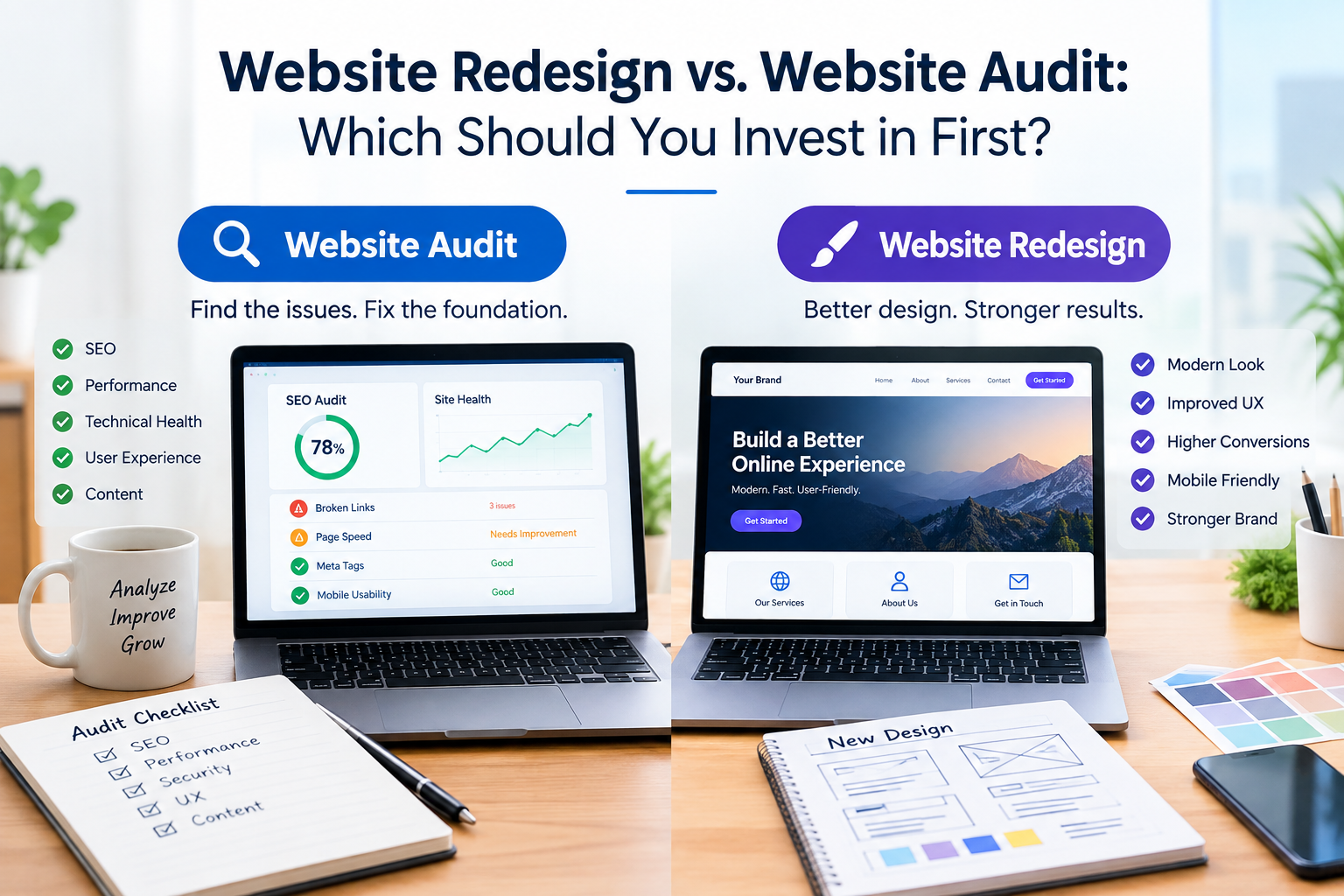
Audit vs. Redesign: Understanding the Difference
Website Audit | Website Redesign
Finds problems | Changes the website
Evaluates existing pages | Creates or restructures pages
lower initial cost | Usually requires a larger investment
Helps guide decisions | Implements major changes
Can be performed without rebuilding | May involve migration or redevelopment
Focuses on diagnosis | Focuses on transformation
The two processes are not competitors. In projects they work together.
The Risk of Redesigning Without an Audit
A redesign can unintentionally damage existing SEO performance.
For example changing URLs without redirects can create broken links. Removing pages can eliminate traffic‑producing content. Changing navigation can affect linking.
Other risks include:
- Missing metadata
- Incorrect canonical tags
- Indexing problems
- pages
- Lost backlinks
- Poor redirects
- Reduced organic visibility
- New performance problems
This is why SEO should be considered before and, during a website redesign not added after the new site launches.
A Better Process: Audit First, Redesign Second
A practical process looks like this.
Step 1: Audit the Existing Website
Identify problems, content problems, performance problems, user experience problems and conversion problems.
Step 2: Separate Problems From Preferences
Not every issue needs a redesign.
For example a button style that looks old is not the same as a navigation structure that blocks users from finding pages.
Step 3: Identify Business Goals
Decide what website needs to achieve.
Possible goals include:
More organic traffic
More leads
online sales
Better brand presentation
Improved mobile experience
Faster page loading
Step 4: Create a Redesign Plan
Use website audit findings to decide which pages, features, templates and technical parts need to change.
Step 5: Protect Existing SEO
Before launch map URLs set up redirects keep valuable content review internal links and check if pages can be indexed.
Step 6: Audit the New Website
After launch run another website audit to make sure important pages work. That SEO elements were not lost.
What If Your Website Looks Old but Performs Well?
A website does not automatically need a redesign just because it looks old.
If the website brings in traffic and conversions think about a visual refresh first.
You could change:
Typography
Images
Color scheme
Buttons
Page spacing
Navigation
Content presentation
This can give a feel without the risks of a full migration.
What If Your Website Looks Good but Gets Traffic?
This is another case where a website audit’s useful.
A beautiful site may still struggle with:
Search intent
Technical SEO
Content depth
Internal linking
Indexing
Page speed
Keyword targeting
A redesign may not fix these problems.
How Much Should You Invest?
The right amount depends on the website’s problems and business goals.
Of picking the expensive option right away find the gap between the current website and the results you need.
A website audit can show whether you need:
improvements → targeted optimization
Several structural changes → partial redesign
Major UX problems → full redesign
This makes the decision based on facts.
Final Thoughts
For businesses a website audit is a smart first step before a big redesign.
A website audit shows what works, what fails and what improvements are really needed. If the website is built well a targeted optimization may be enough. If there are UX, technical or structural problems a website audit can give a plan for a larger redesign.
The key is to avoid redesigning just because a website looks old and avoid skipping a redesign just because the website already ranks.
Audit first. Understand the problems. Then choose how much to change.
FAQs
Should I audit my website before redesigning it?
In cases yes. A website audit can find SEO, content, technical, performance and UX problems before changes.
Can a website redesign hurt SEO?
Yes. Changing URLs, content, internal links, redirects and technical settings can hurt visibility if not handled correctly.
Does every old website need a redesign?
No. If the website works well a small design or usability update can be enough.
How long should a website redesign take?
It depends on the size of the site its functions, its content, the technology it uses and the migration needs.
Should SEO be part of a website redesign?
Yes. SEO should be part of planning, building, moving and testing after launch.
What should I do after launching a redesigned website?
Check if pages are indexed check redirects find links, review metadata check internal links, test mobile friendliness, test page speed look at analytics and make sure important organic pages still work.
Is a website audit, than a redesign?
Generally a website audit costs less because it reviews the site instead of rebuilding big parts of it. The exact price depends on the site and the work needed.


