
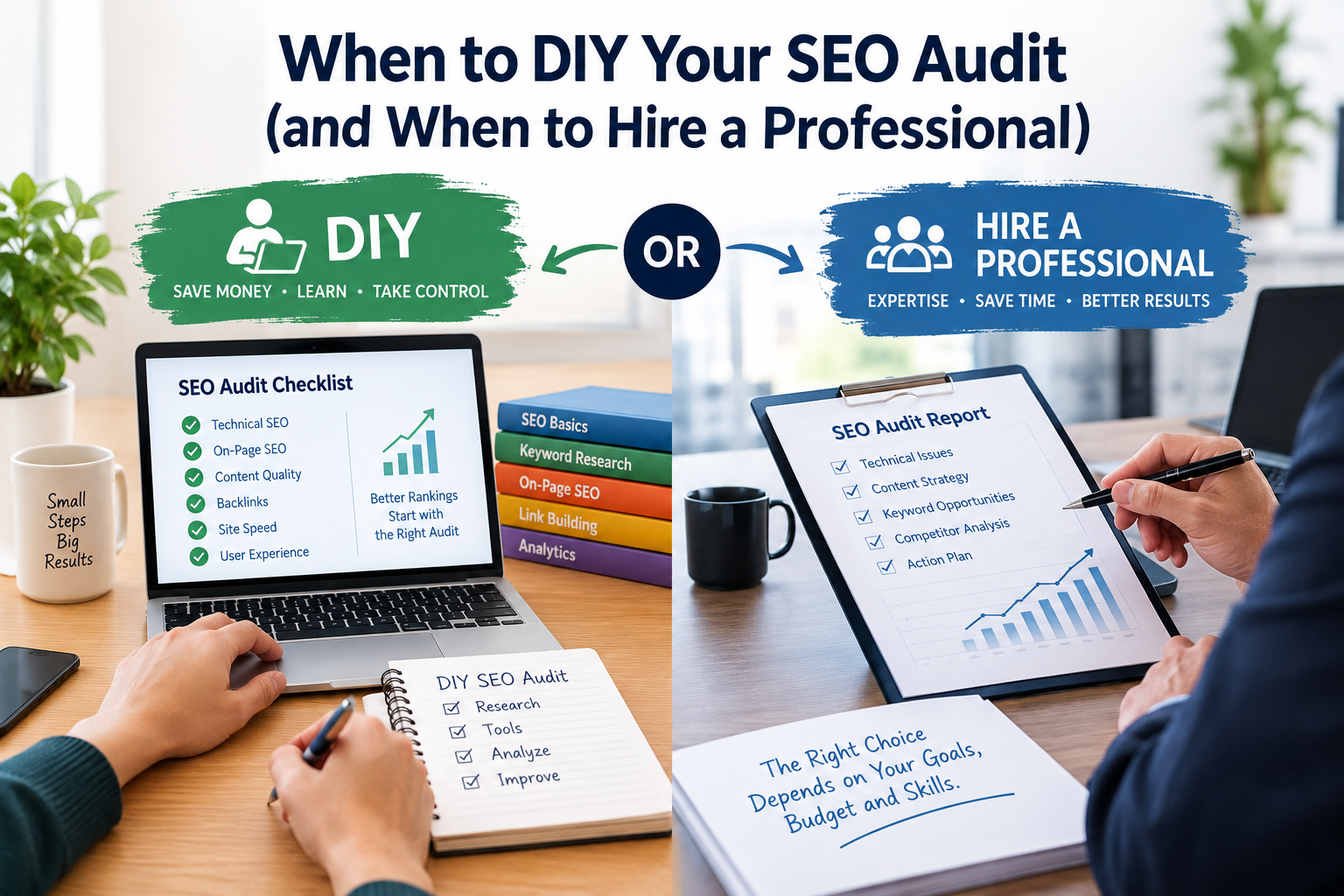
An SEO audit helps you see how well your website is doing in search engines and where things might need improvement. For businesses the real question is not if an audit is helpful but whether to do it yourself or bring in an SEO expert.
The good news is that many basic SEO checks can be done without help. But when technical issues come up or the website is very big or the search problems are complicated then a trained expert may be needed.
What Is an SEO Audit?
An SEO audit is a look at your website’s search performance and technical condition. It reviews parts of your site such as:
Technical SEO
Website speed
Mobile usability
On-page SEO
Content quality
Internal linking
Indexing
Broken links
Metadata
Structured data
Backlinks
Organic traffic
Conversion opportunities
The goal is to find problems and point out ways to make things better.
When You Can Do Your SEO Audit
You can manage your own SEO audit if your website is not too big and you feel comfortable making simple changes.
- You Have a Small Website
If your business website has a few key pages you can go through most SEO elements on your own. Look at these pages:
Homepage
Service pages
About page
Contact page
landing pages
Important blog posts
Check each one to make sure it has a clear purpose, useful content, a good title and proper headings.
- You Are Comfortable With Basic SEO
If you already know about keywords, title tags, meta descriptions, internal links, redirects and indexing then a DIY audit might work for you. You don’t have to be an expert— able to spot obvious mistakes.
- You Have a Limited Budget
Hiring an SEO professional can cost a lot especially if the audit includes technical analysis and ongoing work. A self-managed audit lets you fix issues first before spending money.
- You Want to Learn How Your Website Works
Doing your audit gives you insight into how your website performs. You may discover:
Which pages get visitors from search
Which keywords bring in people
Which pages are not well optimized
Where users might run into problems
Which content needs updating
This knowledge can guide your content and marketing choices.
What You Can Check Yourself
A basic DIY SEO audit covers important areas.
Technical Checks
Look for:
HTTPS security
Broken links
Mobile responsiveness
Slow-loading pages
Redirect issues
Indexing problems
XML sitemap
Robots.txt file
Duplicate content
On-Page SEO
Review:
Page titles
Meta descriptions
H1 headings
Subheadings
Image alt text
Internal links
Keyword relevance
Content quality
User Experience
Visit your site like a customer would. Ask:
Can I immediately understand what this business offers?
Can I find the information I need?
Is it easy to contact the business?
Does the site work properly on my phone?
These simple questions often reveal problems that automated tools may miss.
When You Should Consider Hiring a Professional
Some SEO problems are hard to solve without skills.
- Your Organic Traffic Has Dropped Significantly
A sharp drop in search traffic can happen for reasons. Possible causes include:
Technical errors
Search engine algorithm updates
Indexing problems
Lost rankings
Content issues
Website migration
Manual penalties
Changes in what people search for
A professional can dig into the data and find the cause.
- Your Website Is Large
A site with hundreds or thousands of pages is much harder to examine. Big websites often face challenges like:
Crawlability
Internal linking
Duplicate content
Canonicalization
Faceted navigation
Redirects
Pagination
Indexation
Tools can spot patterns but understanding them usually requires experience.
- You Recently. Moved Your Website
Website migrations need careful attention. Changing your domain, URL structure, CMS, hosting or design can create SEO problems if redirects and indexing aren’t set up correctly. An audit before or after a move can help avoid risks.
- You Have Serious SEO Problems
Some issues require development-level knowledge. Examples include:
JavaScript rendering
Canonical tag conflicts
Structured data implementation
International SEO setup
Server configuration
Complex redirect chains
For beginners these can be confusing and risky to fix alone. A specialist can handle them safely.
- You Are in a Competitive Market
If many strong websites compete for the same keywords fixing basic errors may not be enough. You may need insights into:
Search intent
Content gaps
Competitor tactics
Backlink profiles
Topical coverage
Site structure
An experienced SEO expert can give you a more thorough review.
DIY SEO Audit vs. Professional Audit
For example:
Step 1: Check website speed and mobile friendliness.
Step 2: Review page titles and headings.
Step 3: Find links.
Step 4: Examine content.
Step 5: Check indexing and sitemap issues.
Step 6: Look at traffic trends and rankings.
If you find problems that’re too hard to handle then hire an SEO professional for a deeper review. This way you learn about your site. Only pay for help when it’s really needed.
Questions to Ask Before Hiring an SEO Professional
If you decide to go with a professional ask what their audit will cover.
Good questions to ask:
What parts of SEO will you check?
Will you look at SEO?
Will you analyze traffic and search results?
Will you give recommendations ranked by importance?
Will you explain why each suggestion matters?
Will they help with implementation?
How will success be measured?
Be careful about anyone promising guaranteed results or instant ranking improvements. SEO success depends on competition, user behavior, website quality and how well you follow advice.
Final Thoughts
A DIY SEO audit can be a first step for small businesses with simple websites and basic SEO needs. You can catch common mistakes without hiring help.
Large sites, sudden drops, in traffic, recent migrations or tough technical issues may call for expert knowledge.
The best path is to match the level of SEO help to your website’s complexity. Start with what you can understand and fix. When things get beyond your skill level bring in someone who knows what they’re doing.


